
Enter password to view case study
Customer support environments often struggle with complex interactions that require coordination between multiple teams and adherence to policy frameworks.
Our legacy infrastructure relied on fragmented, manual processes, making it difficult to track progress across teams and leaving essential data scattered across different systems. This created high cognitive load for support agents, delayed resolution times, and limited visibility into the root causes of recurring issues.
ROLE
COMPANY
Timeline
SKILLS
47,000
Cases created & managed
77% One-touch
Resolution rate
5 x faster resolution
Resolution 39 days → 7 days
The problem
Agents couldn't see when issues were actually resolved.
No clear ownership or accountability when a problem spanned multiple touchpoints.
Context was fragmented across chats, tasks, and other entities, so agents lost the thread.
No way to track time spent or resolution status.
No structured way to verify resolution or measure satisfaction.
My role
I led the design strategy to consolidate fragmented workflows into a unified Case Management system.
My objective was to transform how the organisation tracked customer issues, ensuring agents had immediate, holistic visibility into case history to improve:
Resolution speed
Resolution quality
Visibility across the customer journey
Framing the problem
My approach focused on systemic design rather than isolated task management.
Discovery
I conducted ethnographic shadowing of support teams across various business units, understanding the user profiles that would be using the solution day to day.
This allowed me to:
Map constraints
Identify pain points
Distinguish between processes that were standardised and those requiring bespoke handling
Framework development
Rather than overwhelming the team with a completely new process, I developed a case entity model.
This framework linked disparate elements — such as customer dialogues, transaction logs, and external files — into a single, navigable source of truth.
Iterative design
I worked closely with engineering to maintain a tight feedback loop.
We prioritised a low-friction rollout, starting with a minimum viable product that focused on adoption before automation.
This allowed agents to become comfortable with the case structure before we introduced more advanced AI-driven tools.

Defining the solution
Me & the engineering team developed a case-building system that allows users to connect all the moving parts to a single entity, providing full context and understanding of a categorised customer problem.
The system brings together information that previously lived across different tools and makes it possible to:
Centralise artefacts from internal tools, regardless of where they originated — including chat messages, transactions, and file attachments.
Track the full lifecycle of a case, including agent touchpoints, required sub-tasks, and duration before resolution.
Identify friction in workflows through analytics on recurring problem areas.
Create a single source of context around a customer problem, rather than forcing agents to piece information together themselves.
Operationalising the solution
During the defining phase, I built operational workflows showing how the system would work in production, alongside a PRD to align with the engineering team ahead of implementation.
The PRD brought together:
Project background
User personas
Product requirements
Entity relationships required to successfully build the solution


Operation workflow & wireframes


Prototyping & testing
Agents were accustomed to managing dialogues, so the new system introduced a slight change to their existing workflow.
I built a quick prototype using Claude Code and my design system, which I was able to use to test the concept with a small group of representatives from the team. I created dedicated process flows to help them become familiar with the case interface and understand how to connect different artefacts to a case.

This interface has been recreated for illustrative purposes and does not depict the actual production tool.
We then released the initial version to production, allowing agents to build familiarity with the concept of case creation without imposing immediate operational or process changes on specific roles.
In subsequent releases, we gradually introduced more capability:
LLM-powered summaries — giving agents instant context when joining an existing case.
Automated workflows — reducing the manual effort involved in managing cases.
Case actions — enabling agents to take structured actions directly within the case.
Trade-offs
For the first release, delivering the full solution would have required significant changes to our existing widgets and workspaces. We instead scaled the design back to an MVP, allowing agents to start building cases and linking artefacts with the tools already in place.
This approach added some operational time to the process, but it also gave us a chance to involve agents early and gather feedback on the first release. Over time, we used those learnings to refactor and rebuild the widgets, making it simpler and more seamless to connect artefacts.
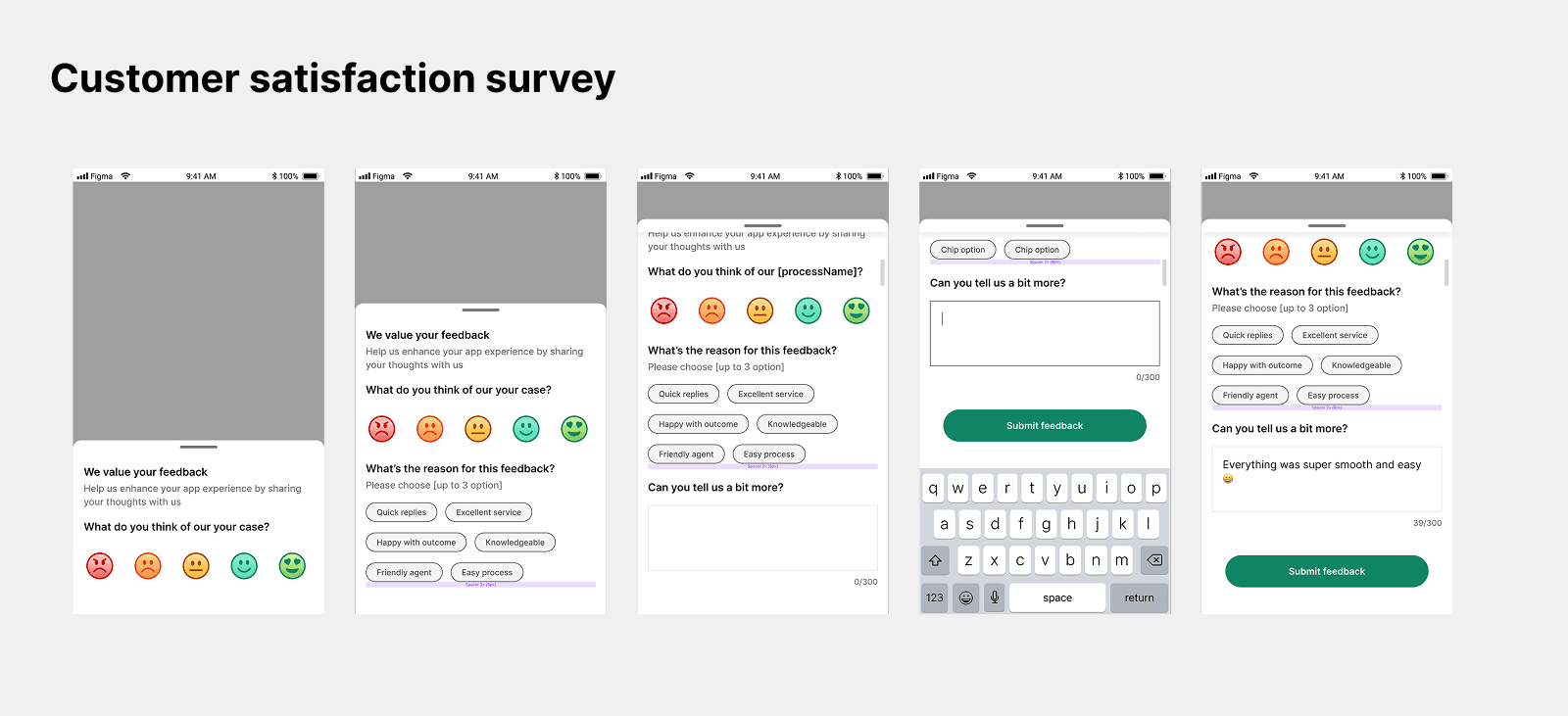
Customer feedback - CSAT
Alongside the operational improvements, we also captured customer feedback and satisfaction data to understand how changes to the case management experience were affecting the wider customer journey.
This feedback helped inform the design of a mobile experience, ensuring that case context and key actions remained accessible when agents needed to work away from their primary desktop environment.
Results
Operational scale — The workflow has successfully managed 47,000+ cases, with a 77% resolution rate since release.
Resolution speed — We achieved a 5× improvement in resolution time, reducing median time-to-resolve from approximately 39 days to 7 days over a one-year period. This gave customers a more reliable and predictable resolution experience.
Workflow efficiency — By centralising artefacts such as communications, transaction history, and associated files, the CX support team reduced the need for fragmented manual follow-ups and time spent searching for case context. Agents could access the information they needed within a single case, giving them more immediate, actionable context for complex issues.
Retro
Following the implementation, I led a small focus group and retrospective with support agents to understand how the solution was performing in practice.
We discussed:
What was working well and where the new workflow was helping agents.
What wasn't working as well, including friction introduced by the new case structure.
Feedback and improvements that could make the experience more effective.
Future needs and feature ideas that agents wanted to see in subsequent releases.
The retro gave us a way to feed operational experience back into the product, helping shape what we prioritised next rather than treating the initial release as the finished solution.
